Clubfoot
Kiss of the Spider WomanClubfoot is a recurring antagonist in the wartime film story Molina recounts to Valentin, a figure whose distinctive gait makes him recognizable even as his alliances blur the line between political resistance and organized crime. He appears first beside a truck carrying hoarded food, then as the man who directs the killing of a chorus performer, and finally as the coercive recruiter who forces Leni into a mission against the German forces. His story ends when Leni’s cousin throws himself and Clubfoot through a museum window.
Identity and Appearance
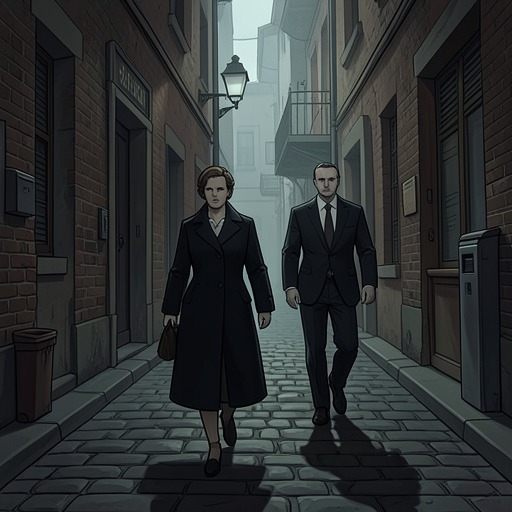
Clubfoot is identified by the conspicuous block beneath one shoe, made of silver and shaped almost like a hoof. The film story also gives him an audible signature: as the chorus performer walks through a dark Paris street, the sound of a step followed by something dragging behind it signals that someone is following her. The narrator recognizes the pursuer as Clubfoot, making his gait both a physical detail and a recurring device of suspense.
His first appearance connects him to a driver with a cross-eyed, criminal-looking face and to a truckload of hoarded provisions. When soldiers arrest a black-market butcher, a crowd gathers outside the store; Clubfoot and the driver stop nearby, conceal the food beneath the truck’s tarpaulin, and reverse away. Clubfoot then enters a Parisian bar and telephones someone to report the butcher’s arrest. Before hanging up, he gives a salute identifying himself and his companions with the French resistance organization. The scene establishes his political affiliation, but places it beside a practical concern with black-market supplies and covert movement through the city.
The Chorus Performer’s Death
Clubfoot’s association with the driver becomes lethal when the blond chorus performer walks to meet the German officer she loves. Clubfoot sees the driver’s coupe arrive, gets in, and signals it to speed away. The performer stoops in the narrow street to pick up the key the officer has thrown from his window; the car runs her down and continues into the empty, dark streets. The officer rushes to her, but she dies in his arms.
The episode connects Clubfoot directly to the killing through his signal and his coordination with the driver. Later, he tells Leni that the performer had been assigned the same espionage mission he now wants Leni to undertake. She had begun an affair with the German officer, fallen in love with him, and refused to continue cooperating; Clubfoot presents her death as necessary to prevent her from denouncing the resistance network to the occupation authorities. The film thus makes his earlier role in the street killing part of a broader pattern: he treats both a woman’s refusal and the danger she may pose to the organization as problems to be removed by force.
Coercing Leni into Espionage
Clubfoot next visits Leni with a young cousin who has arrived from Alsace. He asks her to help locate a major German ammunition dump in France, explaining that the chorus performer had already been working on this mission. Leni is frightened and initially refuses, saying she lacks the courage for such work. Clubfoot counters that the head of German counterintelligence is in love with her, so obtaining documents from him should cost her little. When she still resists, he threatens reprisals.
The threat becomes concrete when Leni sees her cousin lower his eyes, his chin trembling and his forehead beaded with sweat. Clubfoot explains that the young man is being held as a hostage solely because he is her relative, and that the resistance group will kill him if she does not cooperate. Leni agrees to try. She later searches the German officer’s house, fearful of the suspicious majordomo, and ultimately obtains the map of the ammunition zone by taking the key to the officer’s desk. During a garden gathering, she escapes detection by hiding on a balcony while a record plays; when it ends, the guests applaud, believing she has performed live at the piano.
At a meeting in a vast museum overlooking the Seine, Leni tells Clubfoot that she has the information. He warns that this is only the beginning: once she is involved in spying, there can be no withdrawal. She nearly decides to withhold the location, but seeing her cousin trembling, gives Clubfoot the name of the region and the exact village where the ammunition is hidden. He then taunts her with the prospect that the German officer will despise her when he learns of her treachery. His methods are not persuasion but hostage-taking, threats, and the conversion of one coerced act into an obligation to continue.
Death and Narrative Role
Leni’s cousin responds to Clubfoot’s taunt by trying to push him through the museum’s enormous glass window. Clubfoot struggles, and the cousin hurls both of them into space, sacrificing his own life. Leni disappears into the crowd gathering below, protected by her veiled hat. Clubfoot’s death ends his immediate hold over her, but comes at the cost of the hostage’s life.
As a figure in a story told by Molina, Clubfoot is introduced through memorable physical signs and a sequence of escalating actions: the silver-blocked shoe, the dragging step, the hidden provisions, the car that kills the chorus performer, and the museum window. His stated allegiance to the French resistance organization sits uneasily beside his dealings in concealed food and his willingness to murder and threaten civilians. The story does not resolve that contradiction; instead, it makes Clubfoot the agent through whom political purpose becomes entangled with criminal methods and personal coercion.